
Fique por dentro das novidades
Inscreva-se em nossa newsletter para receber atualizações sobre novas resoluções, dicas de estudo e informações que vão fazer a diferença na sua preparação!
Questão ativa
Já visualizadas
Não visualizadas
Resolução pendente
Questão anulada
Sem alternativas

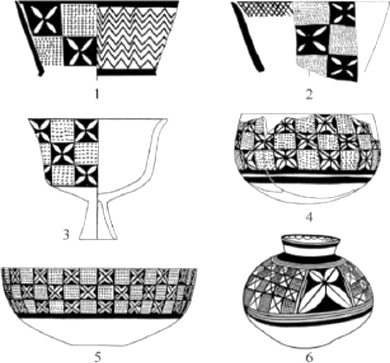
Images of plants painted on pottery made up to 8,000 years ago may be the earliest example of humans’ mathematical thought, a study has found.
Researchers from the Hebrew University of Jerusalem examined pottery produced by the Halafian people of northern Mesopotamia, who lived between 6200 BC and 5500 BC.
Many bowls featured flowers that have been depicted with four, eight, 16, 32 or 64 petals. The use of these numbers forms a “geometric sequence” that implies a form of mathematical reasoning rooted in symmetry and repetition, the researchers said in the study published in the Journal of World Prehistory.
The researchers examined pottery fragments from 29 Halafian sites, excavated over a 100-year period from 1899. They found that in nearly every one of the 375 fragments that depict flowers, the number of petals is determined by this doubling sequence, which divides a circle into symmetrical units.
The Halafians may have developed this form of mathematical reasoning in response to managing village communities that had existed in the Near East for some 4,000 years and had become economically complex, the researchers said.
The ability to divide space evenly, reflected in these floral motifs, likely had practical roots in daily life, such as sharing harvests or allocating communal fields.
The researchers said the Halafian use of the numbers four, eight, 16 and 32 may reflect an earlier and simpler level of mathematical thinking that was in use in the Near East in the 6th and 5th millennia BC. According to the researchers, these patterns show that mathematical thinking began long before writing.
CNN.com. 16 January 2026 (Adaptado).
No texto, a referência à “geometric sequence” (3º parágrafo) é empregada para
indicar que os artesãos halafianos dominavam sistemas formais de cálculo semelhantes aos desenvolvidos na matemática clássica.
sustentar a interpretação de que os padrões decorativos revelavam raciocínio estruturado baseado em progressão numérica e simetria.
sugerir que os motivos florais possuíam função estética desvinculada de organização numérica.
demonstrar que a cerâmica constituía sistema formal de escrita numérica utilizado para fins administrativos.
estabelecer que a divisão do círculo em unidades iguais correspondia a uma convenção artística difundida na Mesopotâmia antiga.
No texto, a referência à “geometric sequence” (3º parágrafo) é empregada para sustentar a interpretação de que os padrões decorativos revelavam raciocínio estruturado baseado em progressão numérica e simetria. Como se lê no trecho “Many bowls featured flowers that have been depicted with four, eight, 16, 32 or 64 petals. The use of these numbers forms a “geometric sequence” that implies a form of mathematical reasoning rooted in symmetry and repetition”.
Em português: Muitas tigelas exibiam flores retratadas com quatro, oito, 16, 32 ou 64 pétalas. O uso desses números forma uma “progressão geométrica”, que sugere um tipo de raciocínio matemático baseado na simetria e na repetição.
Inscreva-se em nossa newsletter para receber atualizações sobre novas resoluções, dicas de estudo e informações que vão fazer a diferença na sua preparação!